
Do AI chatbots make things up? Yes — here is how to stop yours
- ai receptionist
- hallucination
- trust
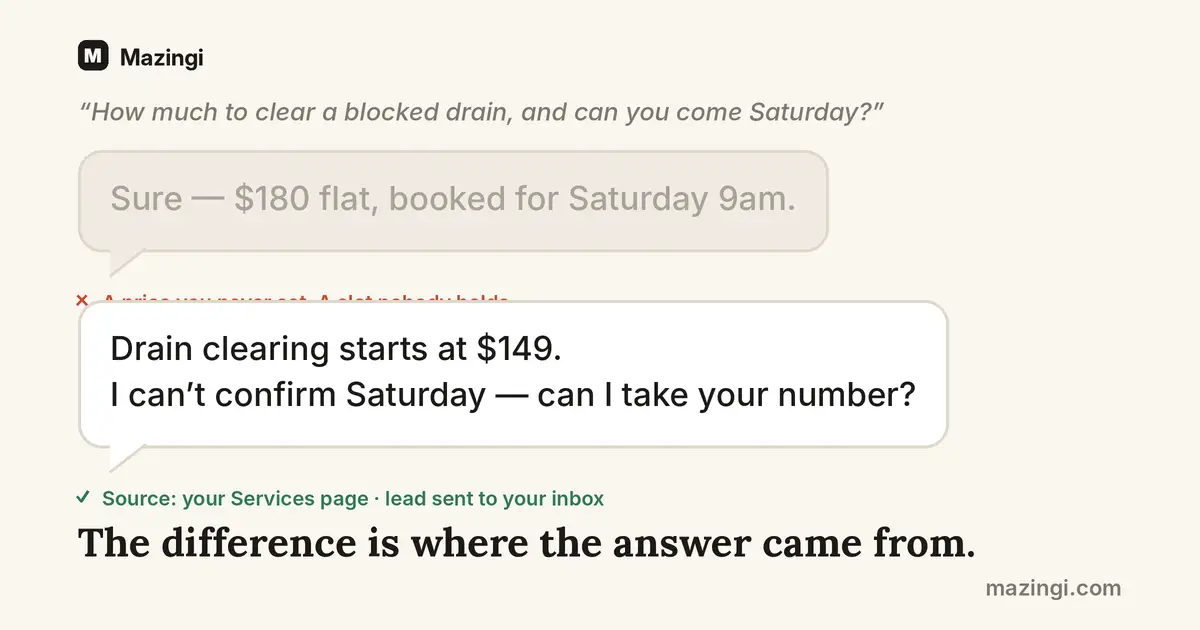
Yes. A language model left to its own devices will answer confidently whether or not it knows — invented prices, policies you never wrote, appointments nobody can honour. The technical term is hallucination, and for a business it is the whole objection: one made-up quote costs more trust than a hundred good answers earn.
The fix is not a smarter model. It is architecture — three constraints that turn "an AI that chats" into "an AI that answers for your business".
1. Ground it in your content, and only your content
The model should not answer from its general training. It should retrieve the relevant passages from material you supplied — your service pages, rate sheet, FAQs — and compose an answer from those passages alone. If your call-out fee is on your site, it quotes it. If it is not, there is nothing to retrieve, and the honest behaviour is to say so and take the person's details instead.
This is why "point it at your website" is not just convenient setup. It is the boundary of what the AI is allowed to claim.
2. Make it show its sources
An answer with a citation can be checked; an answer without one has to be trusted. Every answer Mazingi gives shows which of your pages or documents it came from — which does two jobs. Visitors can verify. And you can audit: skim conversations and see exactly where any answer originated, instead of wondering what the bot said while you were out.
3. Make "I don't know" a feature, not a failure
The most dangerous chatbot is the one that always answers. A grounded receptionist should notice when your content does not cover a question, decline to guess, and capture the enquiry for a human. Ours also logs every question it could not answer — which quietly becomes a list of what your website is missing, written for you by your own customers.
Some subjects should be refused even when your content touches them. A receptionist for a dental practice can triage urgency; it should never diagnose. One for a law firm can capture the practice area and deadline; it should never advise.
What can still go wrong
Honesty requires the other half: grounding narrows hallucination, it does not repeal it. A grounded bot can misread a passage, or combine two of your prices into one wrong number. Two things keep that survivable — citations, so errors are traceable rather than mysterious, and a takeover inbox, so a human can step into any conversation the moment judgement is needed. If your source content is wrong, the bot will be confidently wrong with it; the audit trail tells you where to fix it.
Questions that expose any vendor in five minutes
- "What happens when it doesn't know?" — the answer should be it says so and captures the lead, not "it rarely happens".
- "Can it show where an answer came from?" — no citations, no audit.
- "Will it quote a price that is not in my content?" — the only good answer is no.
- "Can I read the conversations afterwards?" — you are accountable for what it says; you need to be able to see it.
Then run the test that beats every claim, including ours: point it at your own site, free, no signup, and ask it something your website does not answer. What it does next tells you everything.
Never miss another customer or booking
Mazingi answers your website visitors 24/7 from your own services and prices, captures the lead, and books the appointment. Free plan forever — 1 receptionist, 50 chats a month, no card.
Start free — no card needed