
What Angi leads actually cost contractors
- lead generation
- angi
- thumbtack
- costs
Ask a contractor what a lead costs and you will get the sticker price — forty dollars, sixty, a hundred for something big. That number is real. It is also not what you are paying.
Three things sit between the price and a job
The lead is not yours. Marketplaces sell the same enquiry to several contractors, commonly three to eight. You are not buying a customer, you are buying a lottery ticket in a race you have to run anyway — the drive, the quote, the follow-up.
A lot of them never answer. Contractors routinely report that a large share of purchased leads go nowhere: no callback, no reply, wrong number. The homeowner filled in a form on a comparison site, got called by five people in an hour, and stopped picking up.
Some were never yours to win. Outside your area, outside your trade, or a price-shopper with no intention of buying. Every one you discover after driving there is a morning gone.
Work it through
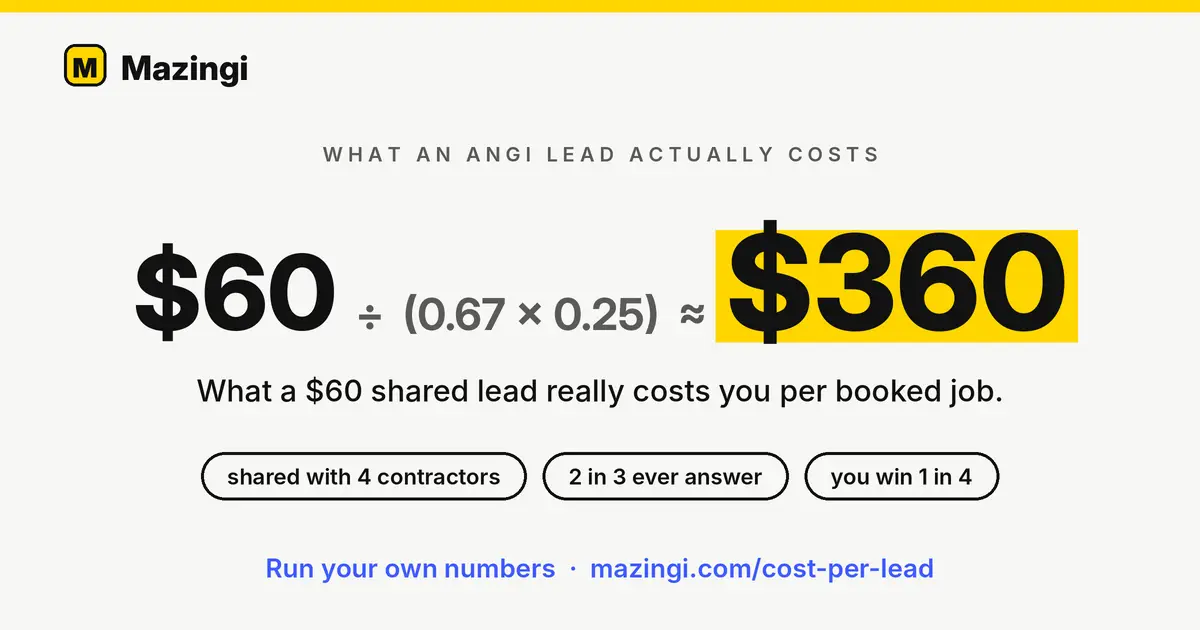
Use round numbers you can change. Say a lead costs $60, four contractors get it, two in three homeowners actually respond, and you win a quarter of the ones you reach.
$60 ÷ (0.67 × 0.25) ≈ $360 per booked job
Three hundred and sixty dollars, before you have poured any concrete. On a $1,200 job that is thirty percent of the ticket gone before materials.
Change the numbers to yours. The point is not the exact figure — it is that the number you are actually paying is not the number on the invoice, and the gap is large enough to change decisions.
The part nobody puts on the invoice
Stop paying and the leads stop that day. Nothing accrues. Five years of buying leads leaves you with exactly what you started with, minus the money.
Compare that to the same spend pointed at your own site. Every review, every page, every returning visitor compounds. The asset is yours and it keeps working when you stop feeding it.
We wrote the arithmetic up in full, with a calculator you can put your own numbers into, on what Angi and Thumbtack leads really cost.
The traffic you have already paid for
Here is what makes marketplace spend particularly frustrating: most contractors are already getting the traffic they are paying for a second time.
People find you — through a search, a neighbour, the van. They land on your website, at nine in the evening, and they leave, because the site had nothing to say and the contact form felt like a suggestion box. That visitor came looking for you specifically. They were not shared with anyone.
That is the cheaper lead, and it is being thrown away silently. We went into why in why your website loses jobs after 5pm.
When marketplaces are the right answer
They are genuinely useful when you have no traffic to convert. A new business with no reviews and no ranking has to buy attention from somewhere, and that is exactly what a marketplace sells. Nothing wrong with it.
The trap is staying for years after your own site started drawing visitors you never answer. At that point you are paying twice for the same customer, and sharing the second one.
What to do about it this week
- Look at your analytics. How many people visited last month? Multiply by three percent — that is roughly how many would have started a conversation if there had been one to start.
- Compare that number to how many marketplace leads you bought.
- If the first number is bigger, the cheaper leads were already on your site.
An AI receptionist answers those visitors at the hours you cannot, asks what you would have asked, and sends you the ones worth calling. Costs the same every month whether it captures two or two hundred.
Never miss another customer or booking
Mazingi answers your website visitors 24/7 from your own services and prices, captures the lead, and books the appointment. Free plan forever — 1 receptionist, 50 chats a month, no card.
Start free — no card needed