
Why your website loses jobs after 5pm
- lead capture
- contractors
- website
Most contractors think their website's job is to look credible. It is not. Its job is to answer the person standing in a flooded kitchen at 9pm deciding who to call in the morning.
That person is not comparing your gallery to anyone else's. They are looking for one thing — can you help, and how fast — and if the answer is not on the screen within about ten seconds, they open the next tab.
The four hours that decide the week
Look at when trade enquiries actually arrive. Not when you invoice, not when you quote — when someone first looks you up.
It clusters into two windows: early morning before work, and mid-evening after dinner. Both are outside the hours anyone answers a phone. A homeowner who has just noticed a leak does not wait for 9am to start researching; they research at 9pm and call at 9am, and by then they have a shortlist.
You are on that shortlist or you are not, and the thing that decided it happened while you were asleep.
What "contact us" actually asks of someone
Put yourself on the other side of the form. To use it, a visitor has to:
- decide their problem is worth typing out
- type it out, on a phone, with no idea how long the reply will take
- trust that a stranger will actually get back to them
- and get nothing at all in return, right now
Every one of those is a reason to close the tab. The form is not a conversation, it is a suggestion box, and everyone knows how suggestion boxes work.
Compare it to what happens when someone can just ask. "Do you do stamped patios?" — one line, an answer in two seconds, and now they are talking to you rather than thinking about leaving.
The lead you never knew you lost
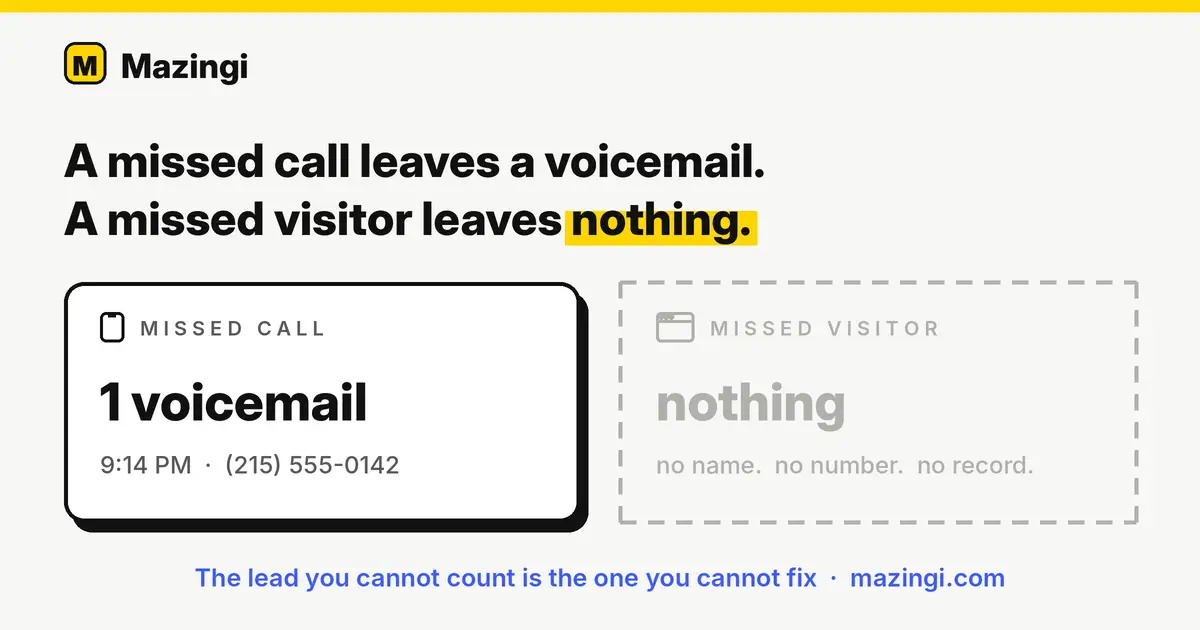
Here is the uncomfortable part. A missed call leaves a voicemail or a number in your log. You know it happened. You can call back.
A visitor who reads your homepage, does not find what they need, and leaves — that leaves nothing. No record, no number, no trace. It is the most expensive kind of lost job because you cannot even count it, which means you cannot fix it, which means it keeps happening.
Whatever you spent to get that person to your site — the van, the reviews, the ads, ten years of word of mouth — you spent it. They arrived. And then the site had nothing to say.
That is the same money you might otherwise spend on marketplace leads, except this visitor came looking for you by name and was not shared with three competitors.
What "answering" means for a trade
Answering is not a chatbot that says "How can I help you today?" and then cannot help you today.
For a trade it means four specific things:
Knowing whether it is urgent. A burst pipe and a bathroom remodel are not the same enquiry and should not get the same response. The first question a plumber asks on the phone is whether water is running right now. Anything answering your website should ask the same thing first, because that answer changes what you do next.
Knowing whether you cover it. Half the enquiries a busy contractor gets are outside the service area or outside the trade. Every one you find out about after driving there is a morning gone. Ask for the ZIP code before it reaches your phone, not after.
Knowing the scope. "Interested in a new driveway" tells you nothing. Six hundred square feet with an old slab to break out tells you whether it is worth quoting this week. The questions differ by trade — roofing needs to know about insurance early, HVAC needs to separate a repair from a replacement.
Getting it to you. A qualified enquiry sitting in a dashboard nobody opens is the same as no enquiry. It has to arrive where you already look — which for most contractors is email, on a phone, between jobs.
The honest limits
An AI answering your website will not close the job. It will not price a complicated repair, judge whether a foundation is sound, or replace the conversation where you build trust. That is still yours, and it should be.
What it does is narrower and more boring: it stops people leaving without a trace, at the hours you cannot be there, and it asks the questions you would have asked anyway. The value is entirely in the enquiries that would otherwise have evaporated.
If your website already answers the phone at 9pm, you do not need this. Most do not.
Where to start
You do not need to buy anything to find out whether this is a problem for you:
- Open your own website on your phone, at night, as if you were a customer with a problem.
- Try to find your prices, your service area, and how long you take to respond.
- Time how long it takes. If it is over ten seconds for any of them, that is your answer.
Most contractors are surprised. The information is usually there — buried in a PDF, implied by a map, or on a page nothing links to. Being on the site and being findable are different things, and only one of them wins the job.
If you want to see it rather than imagine it, you can point our free tool at your own website and ask it what a customer would ask. No signup. Whatever it cannot answer, a visitor could not find either.
Never miss another customer or booking
Mazingi answers your website visitors 24/7 from your own services and prices, captures the lead, and books the appointment. Free plan forever — 1 receptionist, 50 chats a month, no card.
Start free — no card needed